

When should a business be open? Sales by hour
By Jarmo Annunen, CEO11 min readPDF
Also inSuomi
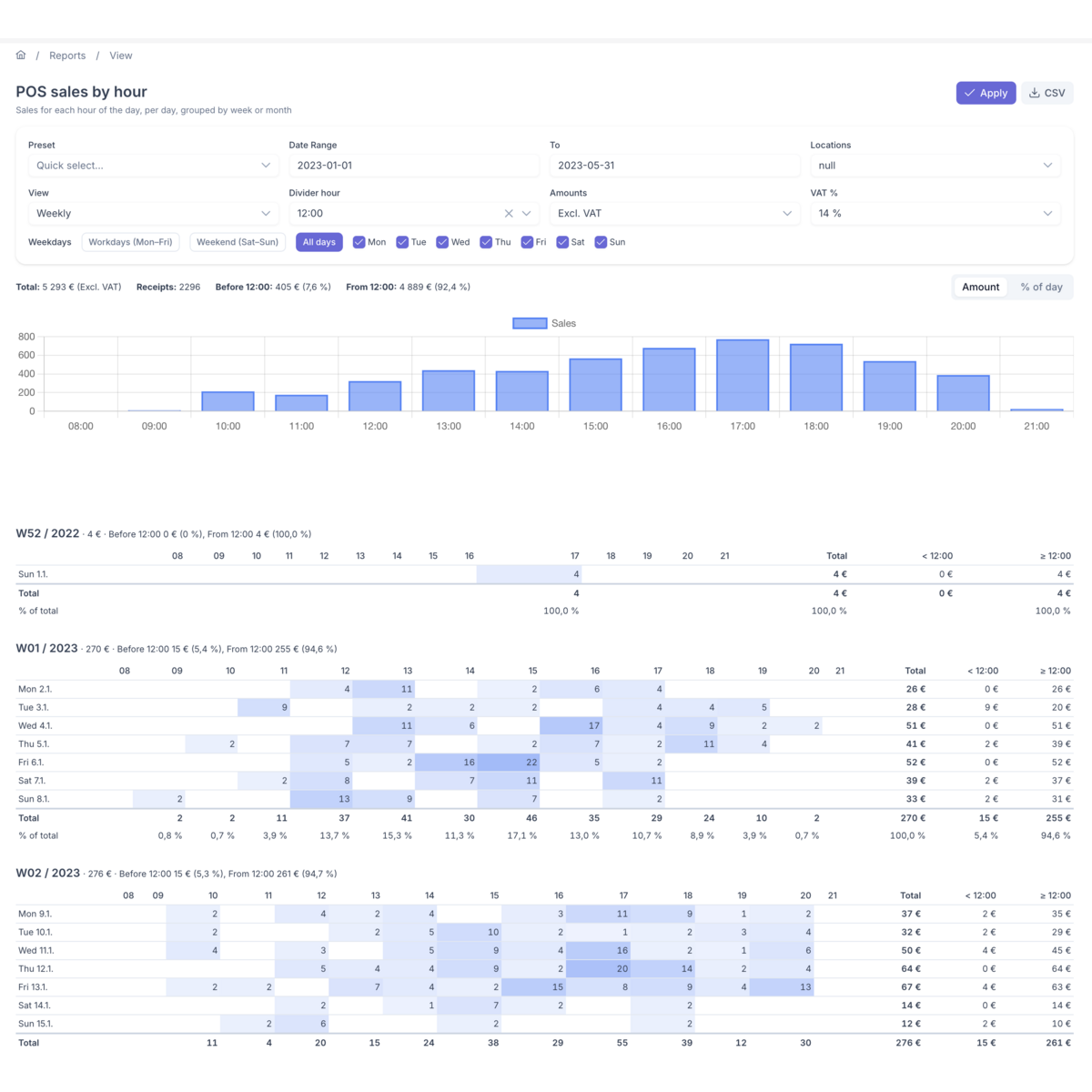
A business's opening hours are rarely decided by calculation. Most often they are what the founder happend to decide, or what they were last year, or what the previous shift lead decided at some point, or what the competitor down the road does. Then someone asks whether you should open at ten on weekends, or close at five on weekday evenings, and you notice you can only answer by gut feeling.
This article is about why that decision is so hard, what the POS sales by hour report in GymKeeper actually tells you about it, and what it leaves out. It is written for anyone who runs a business with opening hours and a till: a gym, a café, a shop, a salon, a sports facility. The thinking is the same.
Why is deciding opening hours so hard?
There are four reasons, and they reinforce each other.
A mistake in one direction shows, and in the other it doesn't. If you keep the business open for an hour when nobody comes, the wage cost shows up on the profit and loss statement. If you close an hour in which five people would have come, the lost sales appear nowhere: nobody checks in to tell you they didn't come. "Let's keep it open to be safe" is therefore always more tempting than it is justified.
One person's story beats a table. Every business has the regular who comes after work at eight. That person is known by name. The thirty others who would rather come at six are not. The opening hours discussion easily turns into one person's story, and it is hard to answer with numbers that you don't have.
The decision has to be made again for every season. What works in November does not necessarily work in June. In summer people are outside, in winter they are inside, and around Christmas behaviour is a thing of its own. One answer is not enough, and you should be able to justify each one to yourself.
Opening hours are a promise to the customer. A customer who buys a monthly membership, a season ticket or a prepaid card is buying a certain level of availability. A change in opening hours is therefore not just a cost item. It can change how valuable customers find what they have bought, and through that whether they renew.
None of this goes away with calculation. But calculation does remove one thing: having nothing to lean on.
What does the POS sales by hour report show?
The report shows how much was sold at the till in each hour of the day, one day at a time. It is based on the till's receipts: every receipt row is counted in the hour of the purchase.
In GymKeeper's report you can:
- choose the date range and one or more locations;
- group the days by week or by month, which gives each week or month its own table with a day on each row and an hour in each column;
- limit the weekdays: quick choices for workdays, the weekend and all days, or pick individual days with checkboxes;
- see each hour's share of the whole week's or month's sales, and switch the view from amounts to % of day, which makes the profiles of days of different sizes comparable;
- set a divider hour: for each day and for the whole period the report shows how much was sold before that hour and from it onwards, in euros and as a percentage;
- see the amounts with or without VAT, and limit the sales to particular VAT rates and, if you use revenue buckets, to particular buckets;
- see the number of receipts, a bar chart and a heat map in which the busiest hour of the period is the darkest; and export the whole report as a CSV file.
The divider hour is the part that answers the opening hours question directly. "Close at five or at eight" is the same question as "what share of weekday sales comes after 17:00?" You get that number with a single choice.
What does the report not show?
This is a more important section than the previous one, because a wrong conclusion is worse than no conclusion.
It does not show visitor numbers. The report counts sales, not people. A customer who comes in on a membership, a prepaid card or something bought earlier uses the business without any sale being recorded for that hour. An hour with not a euro at the till can be the business's best hour. POS sales therefore underestimate exactly those hours whose users have already paid. The distribution of visitors has to be looked at separately, for example from the visits recorded at the door; see how access control works.
It does not show costs. The report tells you what an hour brings. It does not tell you what the hour costs: wages, supplements, electricity, heating. The decision only appears when you put the two numbers side by side.
It does not show where the customer goes when you close. If you close at eight and the sales after eight disappear from the report, you cannot tell how much of it moved to seven and how much was lost altogether. That is only found out by trying.
It shows the moment of purchase, not the moment of use. An entry ticket is bought on arrival, so as far as entry is concerned the difference is small. But drinks, snacks and merchandise are often bought only at the end of the visit, and they are recorded in the hour in which they were paid for.
How to decide, one question at a time
Below are the questions a business owner actually asks. In each the same idea applies: the numbers are not needed to give you the answer, but to narrow it down.
Should you open at ten or at twelve on weekends?
Start by limiting the report to the weekend (the weekend quick choice picks Saturday and Sunday), set the divider hour to 12:00 and look at several weekends to see what share of the sales comes before twelve.
Two things decide whether the number can be trusted. First, you need several weekends: a single Saturday with a children's party distorts the whole picture. Second, the report only has data from the hours when the business has been open.
If you are open from ten today, you can see how much is sold between ten and twelve, and compare it with the cost of two hours. If you now open only at twelve, there is no number for the morning at all: the report cannot tell you how much would have been sold. Then the only way is to try opening earlier for a limited time and then look at the report to see what the morning brought in. And when you close the morning, you cannot know whether its customers will come later or not at all — that too is only found out by trying.
Put the cost of two extra hours next to the number, and decide in advance what condition the hour must meet. It is worth writing the rule down: "An hour stays open if it covers its direct costs on three weekends out of four." A rule is always better than a feeling, because you can check it and change it.
Should you close at five or at eight?
Limit the report to weekdays, set the divider hour to 17:00 and look at how the share after 17:00 is distributed within the week. A weekday evening's hourly profile is usually different from the weekend's, and so weekdays and the weekend are best kept in separate reports: a combined number describes neither well.
For weekday evenings the answer is often hour by hour, not one for all: perhaps open until eight on Mondays and Wednesdays but only until six on Fridays. Limiting by weekday in the report makes this visible.
Should you stay open on weekends in summer, autumn or winter?
Compare the same weekdays in different seasons, not different weeks with each other. The monthly view puts the months one after another, and the % of day view removes the general sales level of the season, so you see the shape: when the day is busy, not how busy it is.
Two pitfalls. Weather and holidays distort individual weeks, so look at a period rather than a week. And if possible, look at the same period from the previous year: the quietest summer weekend is easier to read when you can relate it to what it was the summer before.
How profitable is it to stay open over Christmas?
The Christmas holidays are the hardest case, because the sample is small: there are only a few such days in a year. You can limit the report exactly to those days in earlier years, but three or four days are not statistics, they are a note. Use them to narrow the answer, not to calculate it.
On the cost side, holiday days may carry higher wages, and their amount depends on the collective agreement and on contracts, so check yours. That is why the next point applies especially to holidays.
Can you keep the business open without staff?
Often the right question is not "open or closed" but "staffed or not". If customers or members can get in through access control, the cost of an hour without staff is small, and the question changes: do you keep the till open, or is it enough that the door is open to them? POS sales tell you when keeping the till open brings in anything; access control tells you how much the place is used even when there is no till.
In practice: seven steps
- Choose one question. Not "what are the right opening hours", but "are the first two hours of Saturday morning worth it."
- Choose a comparable period. Several similar weekdays from the same season.
- Run the report with the right weekday selection and divider hour.
- Look at the shares, not only the euros. The % of day view shows the shape.
- Use the Excl. VAT view when comparing with costs, which are usually without VAT.
- Put the cost next to the hour and write down the condition on which the hour stays open.
- Try it for a limited time and run the report again. Only a trial tells you whether the sales disappear or move.
The CSV export is useful here: you can get hourly sales and the shift roster into the same spreadsheet, with the cost next to the hour.
Frequently asked questions
What time of day does a business sell the most?
It depends on the business, the weekday and the season, and there is no universal answer. A café, a shop and a sports facility have completely different days. For a sports facility, a fairly safe answer is that most sales are made on weekdays between 16:30 and 20:30 and on weekends between 10:00 and 15:00. That is exactly why the report exists: it shows your own business's hourly profile, day by day, so you can base your decision on real data.
How many weeks of data do you need for a decision?
There is no fixed number. The principle is that the decision rests on several similar days, not one. The more atypical days the period contains (events, holidays, exceptional weather), the more days you need for them to even out.
Does the report show the number of visitors?
No. It counts sales. The visits of customers who come in on a membership or a prepaid card do not show up in it.
Can you decide opening hours on POS sales alone?
No. POS sales are one of the three numbers you need: sales, visits and cost. Alone, they underestimate the hours your regular customers prefer and leave the cost visible only in your head.
Should an hour with little in sales still be kept open?
Sometimes yes, if it is part of the promise your customers have bought. Then it is a question of the product, not of a till hour, and the decision is made on that basis. Sales by hour still show how much that decision "costs" at the till.
Last checked: 28 November 2026.